Every sprint has a story. tells it better.
What needs a manager that nobody below them can fix?
Vesper reads every board you monitor and answers that one question. The work that is blocking another team, ranked, with the chain behind it. Not another dashboard.
- No model in the loop
- Every sentence is assembled from a number. It cannot hallucinate, because a fact forced each line.
- Nothing leaves Forge
- Processing and storage stay on Atlassian’s platform. No LLM, no analytics, no declared external egress.
- Reads as you
- Every request carries the viewer’s own Jira permissions. Vesper cannot show anyone a story they could not already open.
The brief
Six things, not six hundred.
An issue earns a place only if it blocks another team, or it is a flagged impediment that has stopped moving. A team blocking only itself is the team lead’s call, and never appears. This is the default view, and the point of the product.
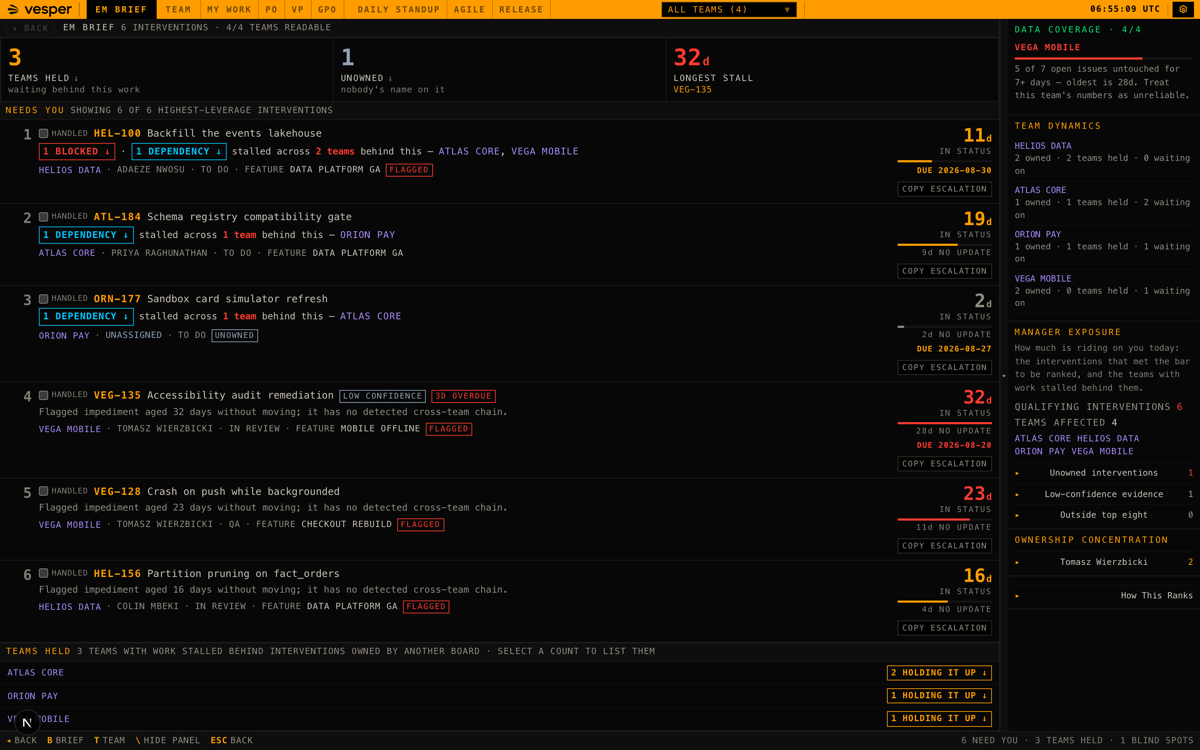
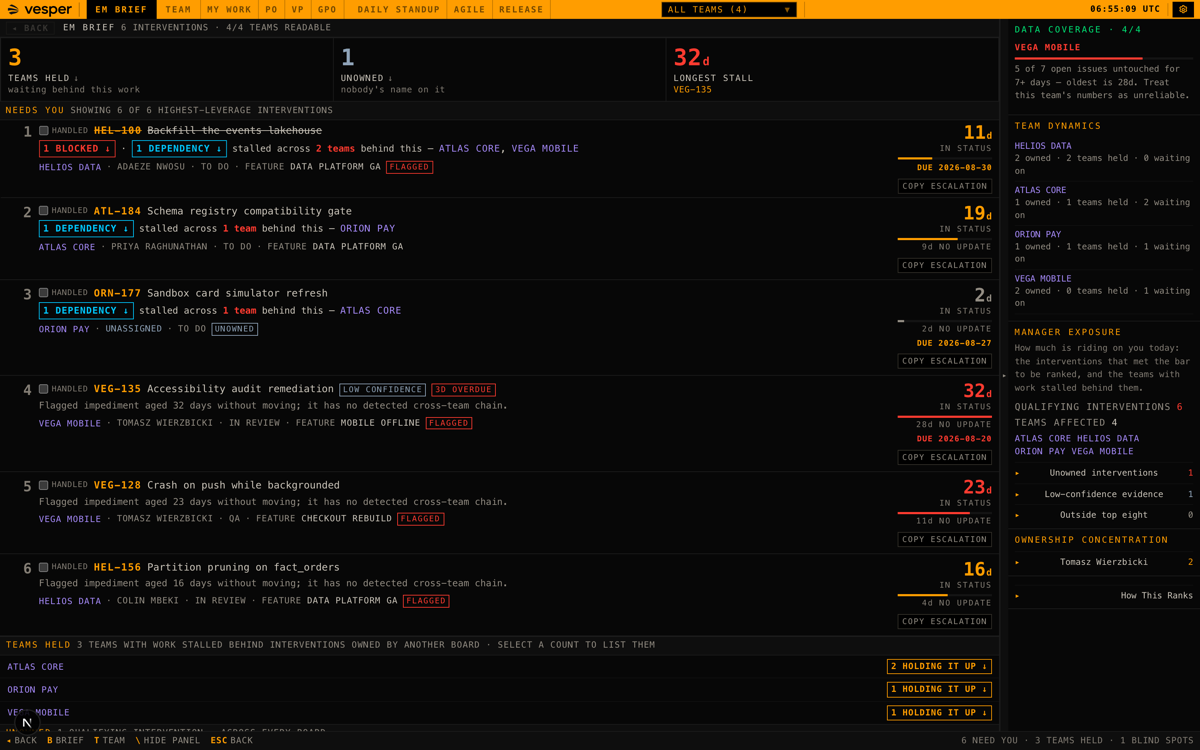
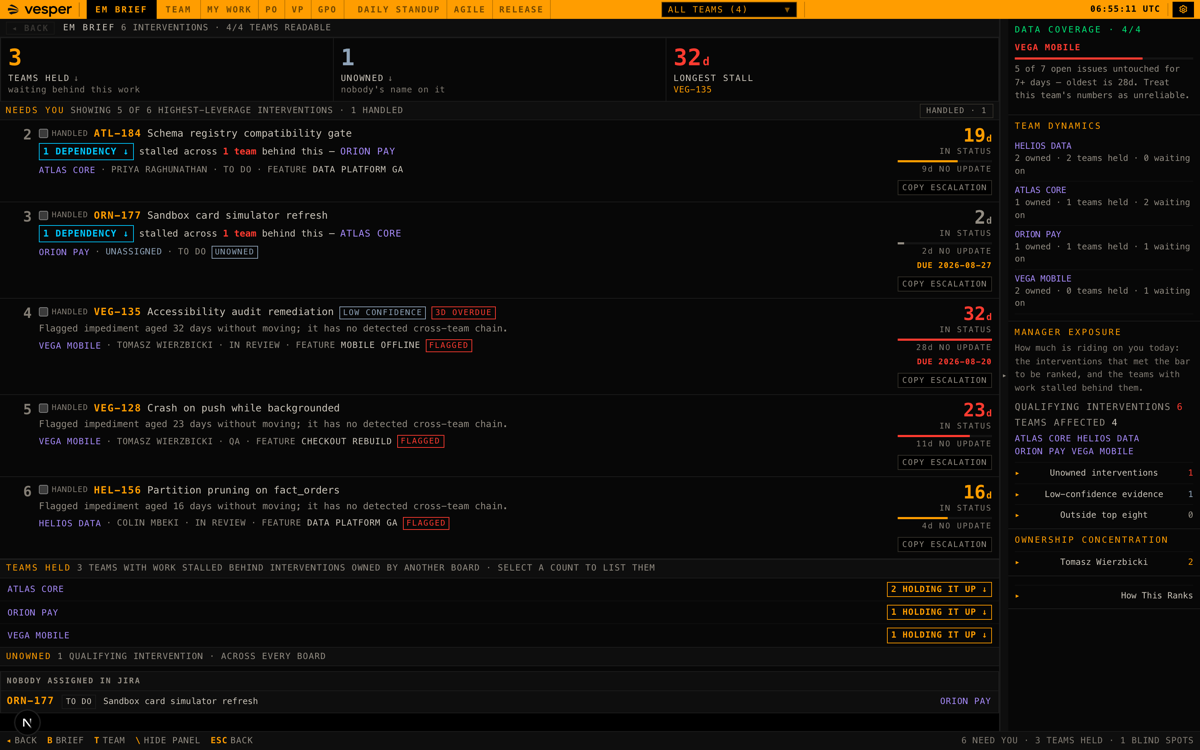
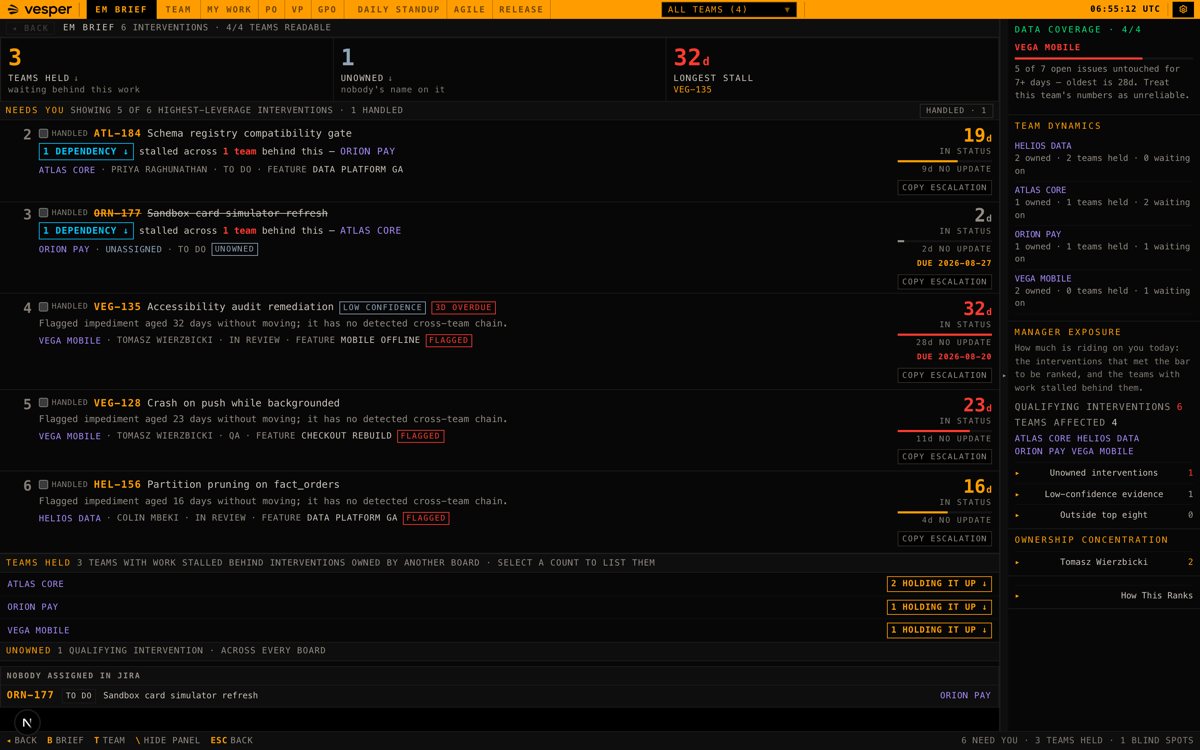
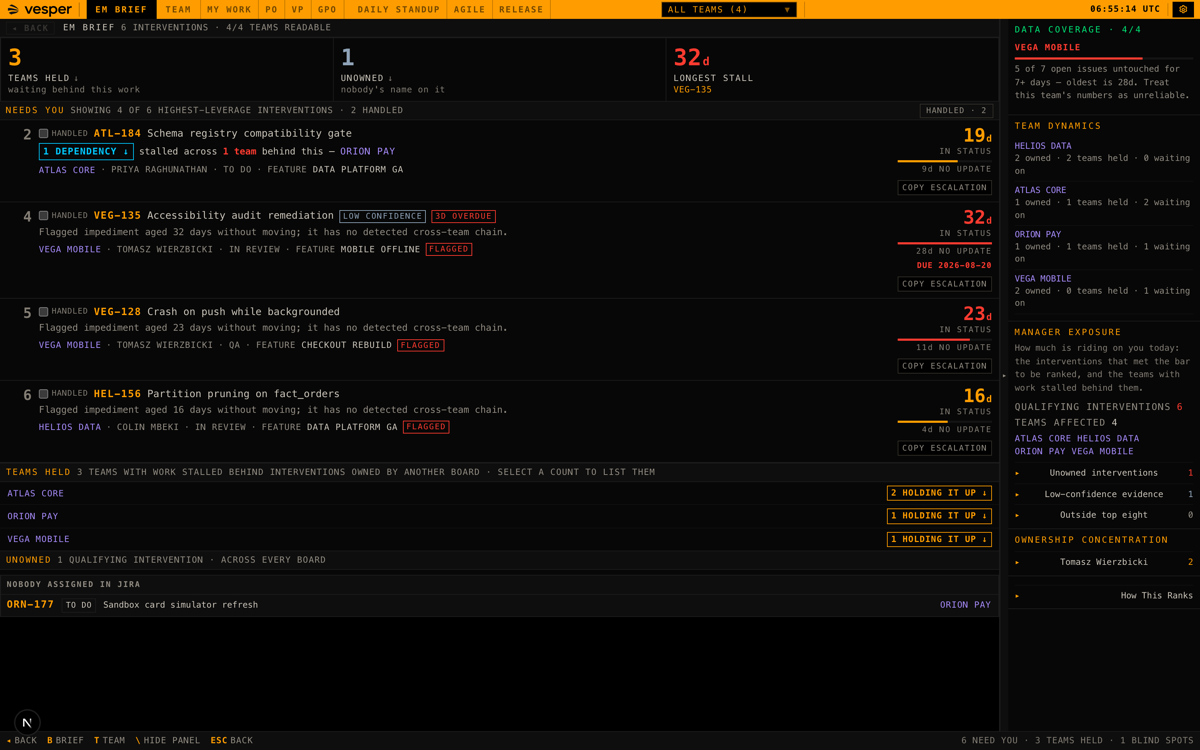
Three teams held, one intervention with nobody's name on it, longest stall 32 days.
| Signal | Weight | Why |
|---|---|---|
| Other teams stalled behind it | 30 each | Only a manager can break a cross-team chain |
| Downstream issues, transitively | 8 each | The scale of the stall |
| Days in current status | 1.5 / day | Age is a decision; a count is not |
| Blocked and unassigned | 15 | Nobody owns it |
| Flagged impediment | 10 | Someone already raised a hand |
| No update in 7+ days | 10 | It has gone quiet |
Also in the brief
- Mark reviewed stamps a baseline, so every later load shows what entered, expanded or left since
- A handled tick that is yours alone, remembered between visits
- Manager exposure: how much is riding on you today, and which teams are stalled behind it
Cross-team chains
The stall that no standup can see.
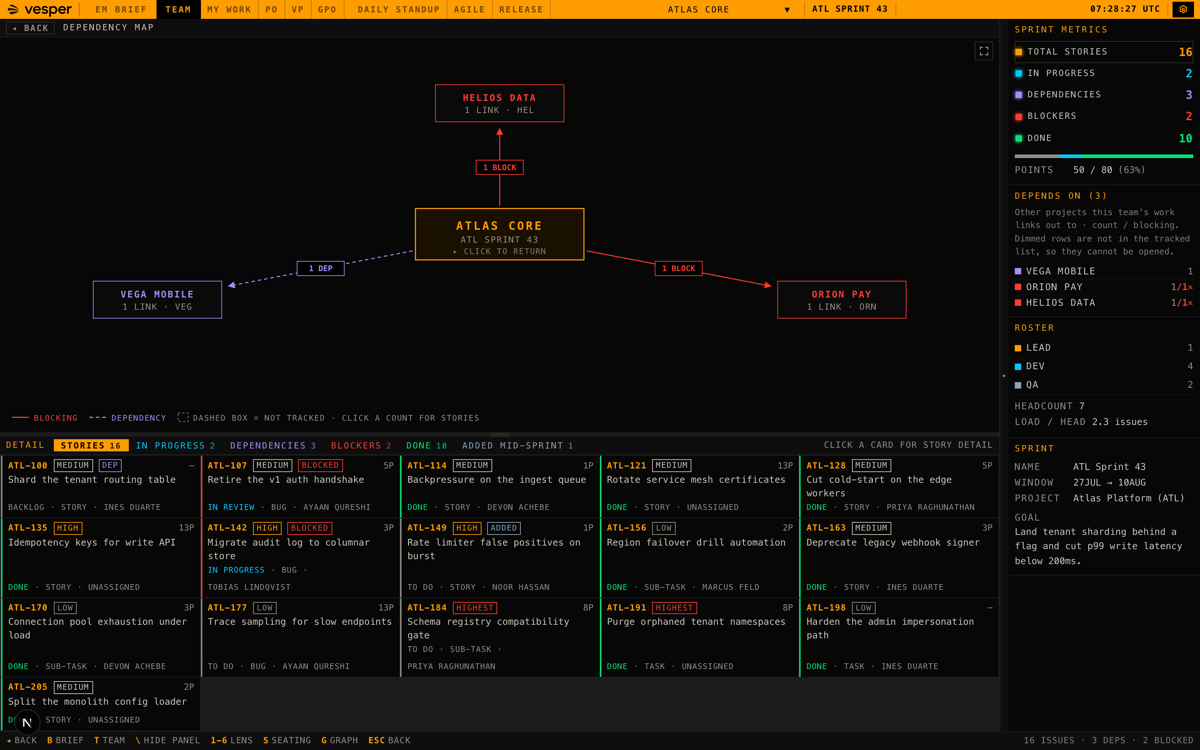
Chains are transitive. If Atlas is blocked by Vega, and Vega is blocked by Orion, then Orion sees the whole tail, because each team only ever knows its own edge. Mutual dependencies, where two teams are each waiting on the other, are marked: from inside either team it looks like one ordinary outbound link, and neither side can clear it alone.
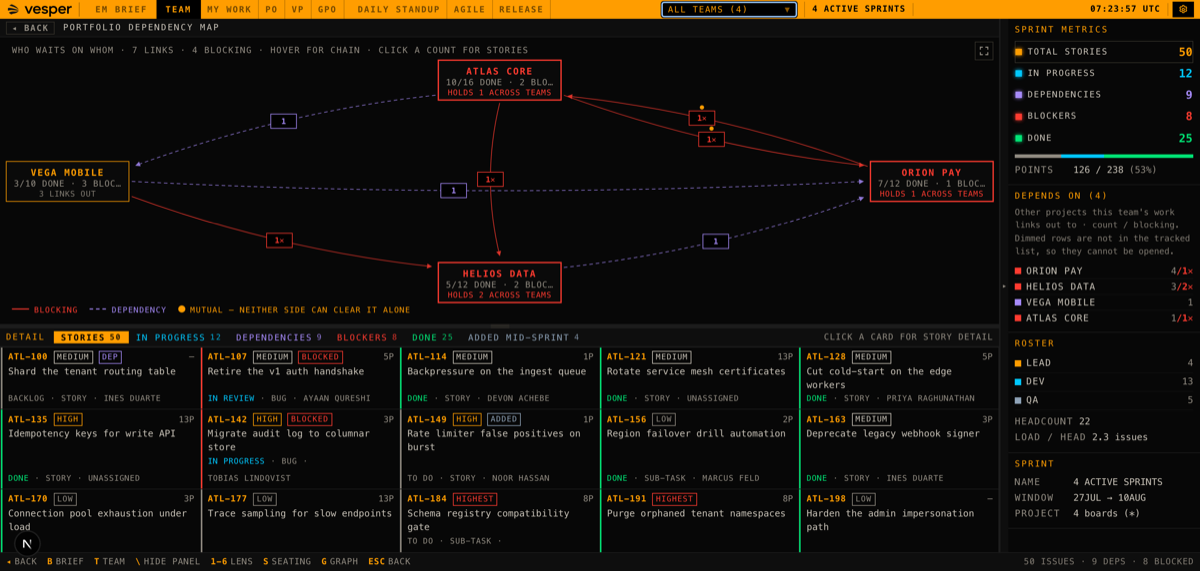
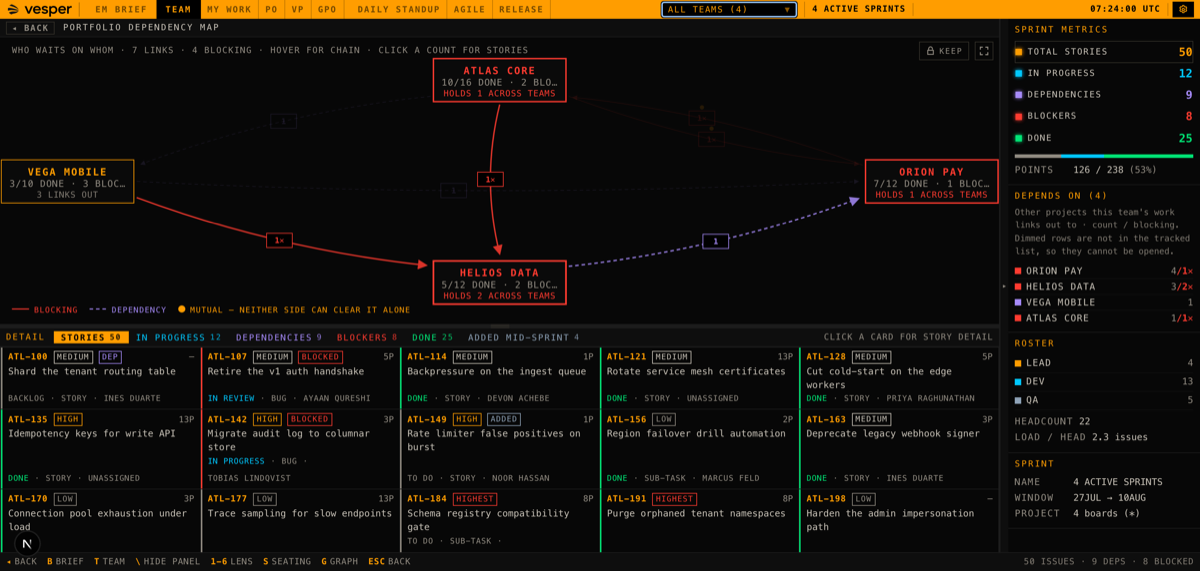
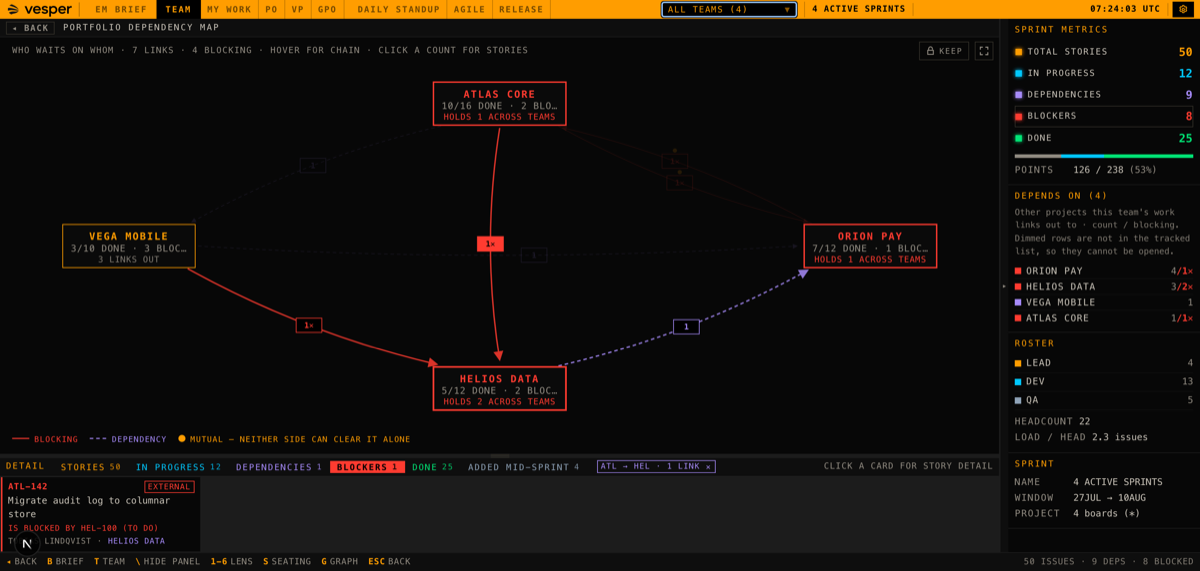
Arrows point at the team being waited on. An amber dot means mutual, so neither side can clear it alone.
Go a level down
- The same graph drawn epic by epic, for features that span teams
- Every link count opens the stories behind it, then the story itself
- Scope to one team without losing the constraint: links out of scope stay on the map
One engine, every working level
One set of facts, rewritten for whoever is reading.
Views select and phrase. They never compute. Two views cannot disagree about a number, because they are reading the same field. Vesper maps each person’s Jira roles and groups to the minimum set of views relevant to them; an administrator can override where your job titles don’t match the defaults.
Manager
What is blocking my teams that only I can fix?
Cross-team chains, ranked, with a ready-to-paste escalation on each row.
Product owner
What is waiting on me, and what got added behind my back?
Unanswered decisions by age, scope injection, open questions by target.
VP
Where does leadership attention change an outcome?
Three decision bullets, material team exceptions, work concentration.
Group PO
Are multi-team features landing together?
Blocked-feature exceptions and per-team delivery spread, with the dependency behind it.
Developer
What changed on my work, and who is waiting on me?
New assignments and mentions, blockers, unanswered questions, and every issue currently pointed at you.
Daily Standup
Who needs a conversation before standup ends?
Per-team updates, blockers, and missing voices, with the Jira evidence behind every prompt.
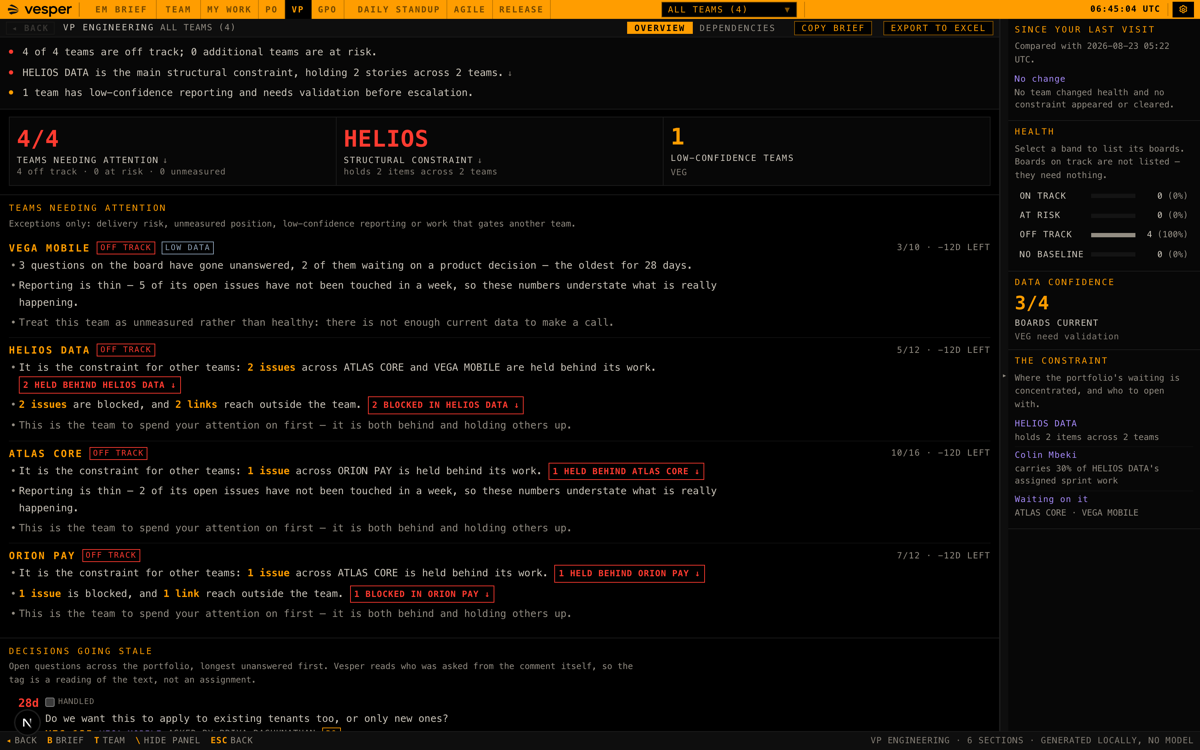
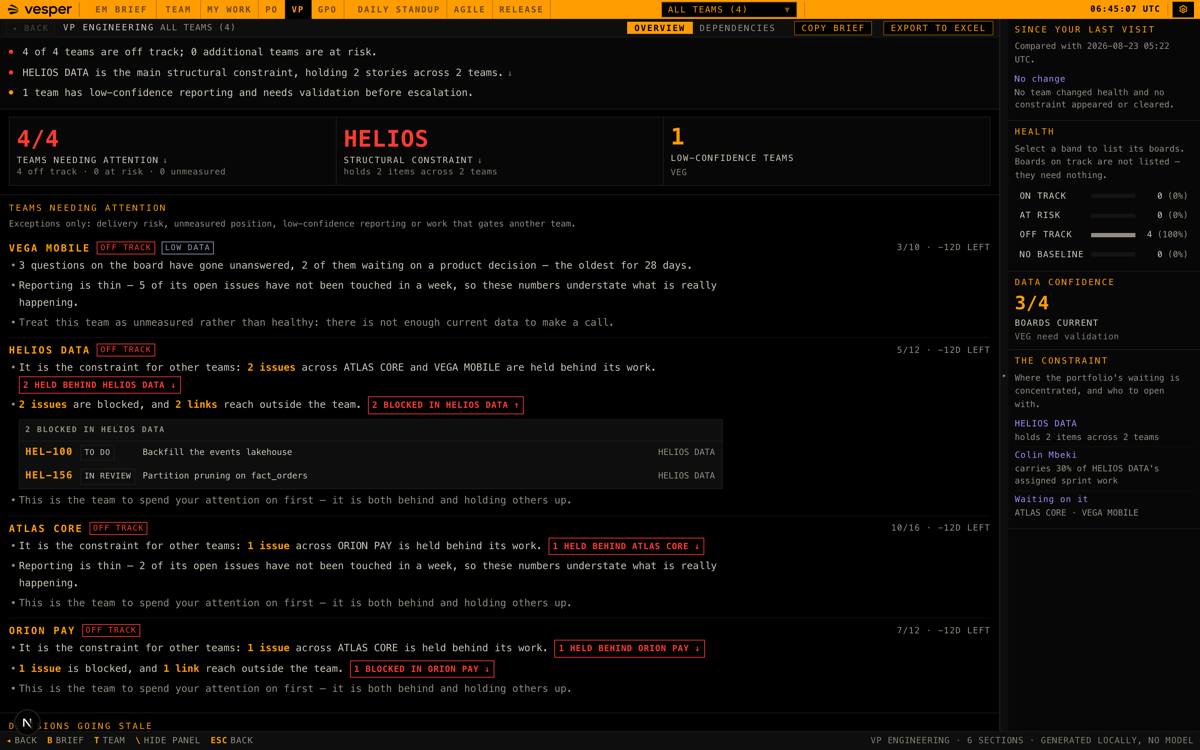
Exceptions only. Boards that are on track are not listed, because they need nothing.
The shared view beneath every role
- Team: the floor plan every other number drills into
Beyond the short list
Three views that answer a question a brief cannot.
Release
Visibility with the data underneath it, not a status somebody typed.
Which version each team is actually carrying, the date on it, and what is still open against it. Vesper reads the project’s whole version catalogue rather than the one somebody remembered to update, recognises UAT, SIT, staging and pre-prod gates by their names, and gives each release a verdict you can open to the issues that produced it. Release trains map to whatever your company calls them.
Agile
Pace you can commit against, before you agree to the next sprint.
Pace here is completion measured against the sprint time actually elapsed, so “on track” is arithmetic rather than a feeling. Beside it: work in progress per head, anything that has not changed status in ten days, and the exact stories missing a sprint, a date or an estimate. Every one of those numbers opens to the rows behind it, which is the difference between a report and a conversation you can win.
My Work
Everything pointed at one person, in one place.
Not a second inbox. What is assigned to you, what landed since you last looked, whose work is stuck behind yours, and the questions sitting unanswered on your own issues. Mentions of you arrive here too, so the thing somebody asked you in a comment on Tuesday is not still sitting there on Friday.
Before and after
Same Jira. None of the scavenger hunt.
Vesper leaves the work where it belongs. It removes the part where somebody opens twenty boards, rebuilds what happened and rewrites it for the next room.
Open every board, filter and comment thread until the pattern appears.
Open one brief. The pattern is already ranked.
Trace one blocker at a time and stop wherever the first Jira link stops.
See the whole chain, then open the exact stories that made it.
Rewrite the same status for a developer, a product owner and the next leadership meeting.
One set of facts, phrased for the person reading it.
Run standup on memory, then chase the voices that went missing.
Recent updates, blocked work and silence are already named.
Let a quiet board look healthy because nothing raised an alarm.
Low coverage and stale evidence say so out loud.
Copy links into a message, then rebuild the same report in a spreadsheet.
Copy the escalation or export the rows behind it.
Evidence
Every number drills to the rows behind it, and comes out with you.
A count you cannot open is a claim, not a fact. Select any figure and Vesper lists the exact stories it was computed from, down to the individual issue.
Then take it somewhere. Copy escalation puts a summary on the clipboard: impact, age, who is waiting, the link. The tool ends in a message rather than a stare. Export to Excel writes a real .xlsx: a sheet per table, with the map on screen on its own tab. Sprint and quarterly reports for a single team come out the same way.
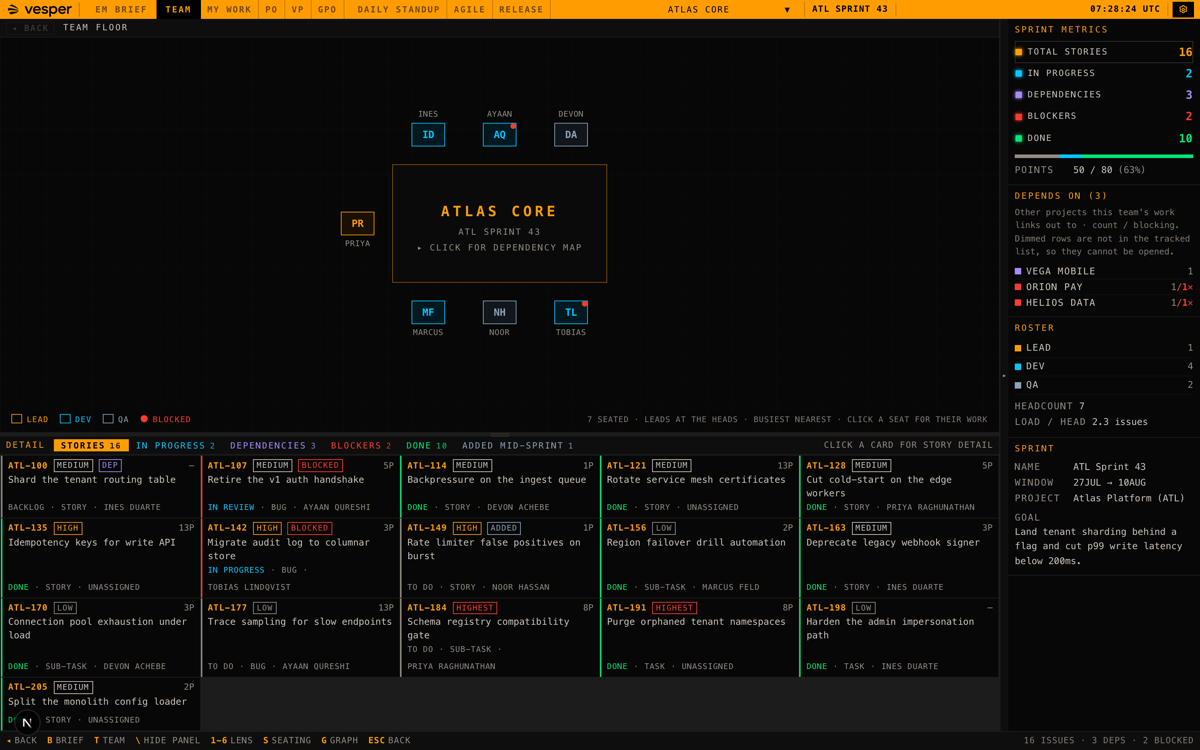
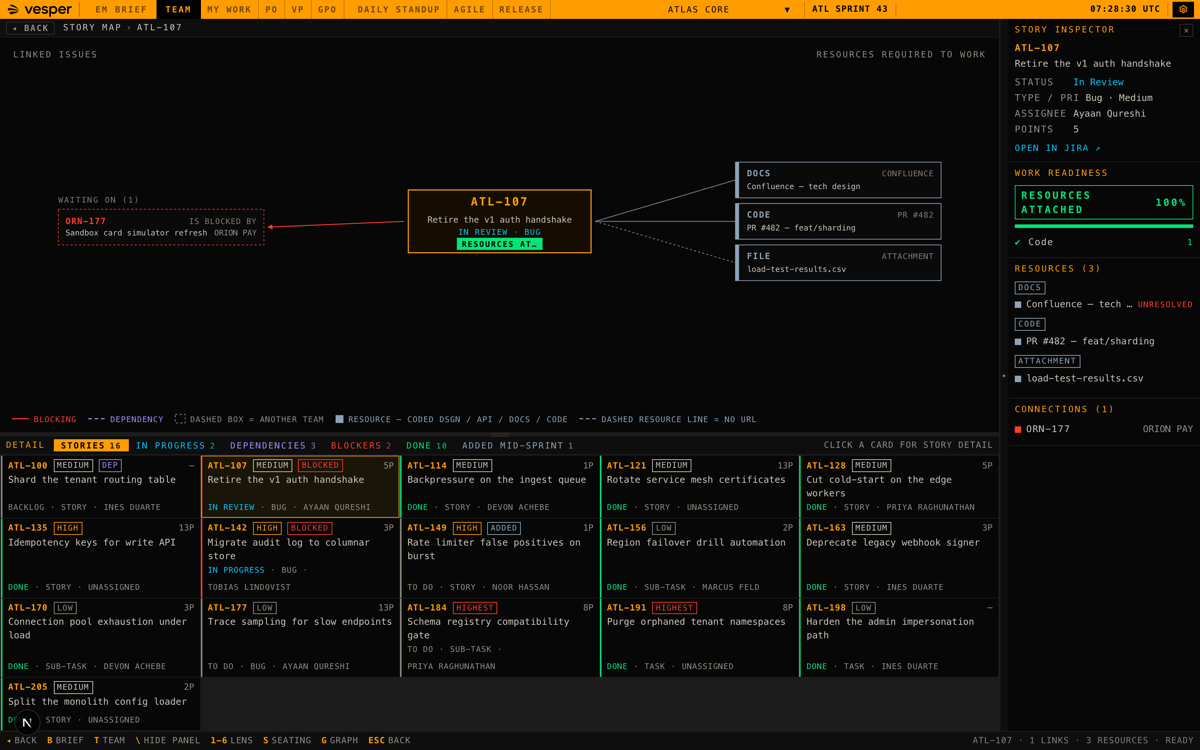
Jira has no board-members API, so roles are inferred from the work in the sprint: lead, dev, QA.
What else the floor shows
- Story readiness: whether the design, spec and doc links an issue needs are actually attached
- Ownership concentration, so a single point of failure has a name before it becomes one
- A seat per person, busiest nearest, blocked marked, and clicking one opens their work
The honesty rule
It tells you when it cannot see.
When a board goes quiet, the honest answer is I cannot see this team. Vesper reports that as a finding rather than hiding it, and tags anything resting on stale data LOW CONFIDENCE instead of presenting it as fact. For a manager that is more useful than a confident chart built on three-week-old tickets.
   YOUR JIRA              THE FACTS                THE SENTENCES              THE VIEW YOU GET
   boards, sprints,  ──►  every number this   ──►  prose assembled from  ──►  the tabs your Jira
   issues, links,         product knows,           those numbers and          roles earn you, each
   comments, versions     extracted once           nothing else               reading the same facts

   Read with your         One pass, one set        A sentence appears         Roles select and phrase.
   own permissions.       of numbers. Two          only because a number      They never compute, so
   Nothing Vesper         views cannot             forced it. No model is     two views cannot disagree
   shows you is           disagree, because        called, so nothing can     about a number they are
   something Jira         they are reading         be invented, and there     both reading off the
   would not.             the same field.          is no per-refresh cost.    same field.
How far that goes
- Comment analysis is local and lexical, so an open question is one nobody answered rather than one a model judged
- Data coverage is reported per board, so you know which teams the numbers are actually about
- Every figure carries the scope it was computed under, including in exported text
- The screenshots on this page are captures of the running app, not mockups. Only the pointer is drawn in, to show where each click landed.
Getting started
Three steps, one admin page.
Install from the Marketplace
No Vesper account, no password, no API token. It runs as a Forge app inside your Jira site and authenticates every reader as themselves.
Point it at your boards
One admin page: monitored boards, Jira field mappings and your company's own terminology, saved together as a single revision. Vesper models one delivery team per Jira project.
Check what actually held
Setup ends on a verification screen that reports which assumptions were true on your instance. A wrong field mapping renders as a zero rather than an error, so Vesper checks instead of assuming.
Made to fit your Jira, not the other way round
- Role aliases, so Vesper recognises whatever your company calls a product owner
- Bulk persona assignment by account, for the people whose titles never matched
- Release train mapping, custom field overrides and your own business timezone
Stop reading twenty boards to find the six that matter.
Vesper is a paid Atlassian Marketplace app for Jira Cloud.